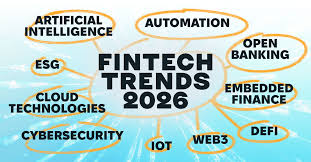
The global banking industry is evolving faster than ever. With digital transformation accelerating, 2026 marks a watershed year for innovation in financial services. From artificial intelligence to embedded finance, banks and fintechs are reshaping how money moves, how customers engage with services, and even how financial products are structured. This article dives deep into the top 10 banking trends transforming finance in 2026, exploring what’s shaping the industry and why these trends matter for customers, businesses, and financial institutions alike.
1. AI and Agentic Intelligence: The New Core of Banking
One of the most disruptive trends in banking this year is the rise of advanced artificial intelligence, particularly agentic AI. Unlike basic chatbots or rule‑based systems, agentic AI can perform multi‑step operational tasks autonomously — from processing loans and detecting fraud to initiating payments and managing compliance workflows. This shift from “AI assistants” to “AI operators” means financial services are becoming faster, more accurate, and more scalable than ever before.
Major financial institutions are now investing billions in AI systems that can fundamentally redesign customer service delivery, risk management, and back‑office efficiency. For customers, this translates into smoother interactions, faster responses to queries, and increasingly personalized financial guidance 24/7.
2. Hyper‑Personalized Customer Experiences
In 2026, personalization isn’t just a buzzword — it’s a strategic imperative. Using AI and machine learning, banks are tailoring financial offerings to individual behavior, spending patterns, and life events. This trend goes far beyond sending basic alerts or marketing offers. AI now analyzes transaction history and financial goals to recommend proactive financial actions such as savings plans, credit optimization, tailored loan rates, or investment opportunities.
Hyper‑personalization enhances engagement and loyalty, as customers increasingly expect financial services that feel custom‑built for their needs rather than one‑size‑fits‑all solutions.
3. Cloud‑Native Infrastructure and Legacy Modernization
To support all this new innovation, banks are rapidly shifting away from legacy mainframes to cloud‑native architectures. Cloud platforms provide scalability, resilience, and speed — essential for real‑time data processing and digital scaling. By 2026, many mid‑sized banks are expected to operate partially or fully on cloud systems, reducing operational costs and enabling faster product launches.
Cloud adoption also enables banks to run advanced analytics, support AI workloads, and comply with regulations with far greater flexibility than legacy systems ever allowed.
4. Cybersecurity: The Ultimate Priority
With digital banking now ubiquitous, cybersecurity is one of the most critical investment areas for banks worldwide. A surge in sophisticated threats — from AI‑enabled phishing to deep‑fake fraud — means institutions must adopt advanced defense tools, such as multifactor biometrics, AI‑powered threat detection, zero‑trust frameworks, and behavioral analytics.
Protecting customers’ data isn’t just about compliance — it’s about trust. Banks that can demonstrate strong security measures build deeper customer confidence and long‑term loyalty.
5. Open Banking 2.0 and Embedded Finance
Open banking has moved past its regulatory roots and into ecosystem‑powered growth. Now often called Open Banking 2.0, this evolution means vast data‑sharing networks and embedded financial services are being built into non‑banking platforms — from e‑commerce and payroll systems to travel apps and gig‑worker marketplaces.
Through APIs and partnerships, banks are now infrastructure providers powering loans, wallets, insurance, and payments behind the scenes. This increases convenience for customers while creating new revenue streams for banks and fintech partners alike.
6. Digital‑Only Banks and Neobanks Rising
Digital‑only banks — also known as neobanks — continue to disrupt traditional banking by offering mobile‑first, low‑cost, and highly intuitive financial services. These institutions don’t rely on physical branches, allowing them to reduce overhead and deliver competitive rates on savings, loans, and payments.
In 2026, neobanks are targeting underserved or niche markets such as freelancers, gig workers, and millennials — segments often overlooked by traditional banks. With enhanced customer experiences and rapid onboarding, digital banks are redefining convenience and choice in retail banking.
7. Blockchain, Tokenization, and Digital Assets
Blockchain technology and digital assets remain transformative forces in banking. Beyond cryptocurrencies, banks are exploring blockchain for secure settlements, cross‑border payments, and transparency in transactions. Tokenization — the process of representing real‑world assets such as bonds or real estate on a blockchain — is gaining traction, offering faster settlement times and lower custodial costs.
Tokenized assets could open new investment opportunities for retail and institutional investors alike, democratizing access to previously illiquid markets.
8. Quantum Computing: The Next Frontier
Although still in its early stages, quantum computing is starting to influence strategic banking decisions. Its potential to solve complex optimization problems — such as risk modeling and portfolio simulations — far exceeds classical computing capabilities. Major financial players are investing in quantum‑secure infrastructures that could redefine pricing models, fraud detection algorithms, and real‑time decision support in the coming years.
While true quantum dominance is yet to be achieved, its influence is expected to grow rapidly beyond 2026.
9. Regulatory Tech (RegTech) and Compliance Automation
As banking becomes more digital and global, compliance complexity also increases. RegTech tools — powered by AI and analytics — automatically monitor transactions, detect suspicious activity, and ensure real‑time regulatory reporting. These innovations not only reduce operational risk but also help banks avoid costly penalties while maintaining customer trust.
Automation in compliance also means banks can scale globally without proportionally scaling back‑office teams, freeing up talent to focus on strategy and growth.
10. The Growing Importance of Financial Inclusion
Digital transformation isn’t just about technology — it’s about expanding access to financial services. In markets around the world, digital banking and mobile finance platforms are bridging gaps for underserved populations, enabling millions to access credit, savings, and payments services that were once out of reach.
This trend is particularly important in emerging economies, where mobile connectivity is high but traditional banking infrastructure is limited.
Conclusion
2026 is a pivotal year for banking. The industry is no longer constrained by traditional models; it’s being reshaped by powerful forces such as AI, cloud computing, open finance, and blockchain. These trends aren’t just technological — they’re redefining customer expectations, elevating security standards, and expanding access to financial services around the globe.
As the banking landscape continues to evolve, institutions that embrace innovation — while maintaining trust and security — will be the ones leading the next decade of financial transformation.
If you’d like, I can also create infographics or summaries for social media based on these top trends!